The provider conversation starts before the buyer has fixed what must actually be delivered.
yellow3 structures the buyer requirement first, then tests providers against it.
From strategy and readiness through provider selection, structured procurement, implementation and proof, yellow3 gives buyers one governed place to make, document and defend the decisions behind a Digital Product Passport programme.
Buyers face developing regulation, uneven public evidence, supplier-data dependencies, contractual lock-in and long implementation chains. The risk is not only choosing the wrong provider. It is making a decision without an evidence record that survives scrutiny later.
yellow3 structures the buyer requirement first, then tests providers against it.
“Compliant”, “interoperable” and “registry-ready” can be assertions without an inspectable artifact behind them.
Identifiers, exports, hosting, resolver continuity and data portability can become expensive constraints after signature.
The programme state stays live: requirements, claims, evidence, provider responses, implementation records, decisions and immutable proof all remain connected. Reports are outputs. The maintained programme is the product.
Buyer source material is ingested and structured. The buyer confirms, corrects and approves.
Provider fit is explained requirement by requirement, never reduced to a score.
The selected provider performs the technical work. yellow3 records workstreams, gates, evidence and acceptance decisions.
Immutable snapshots record what was known, unresolved and approved on a date.
Every product visual below is a fresh export from the current workspace build. The full programme rail is visible. Computed figures that trace to visible record counts remain; there is no overall completion percentage, because none was ever computed.
Mandatory requirements are tested against public evidence, search records and provider-supplied responses while each source remains visibly separate.
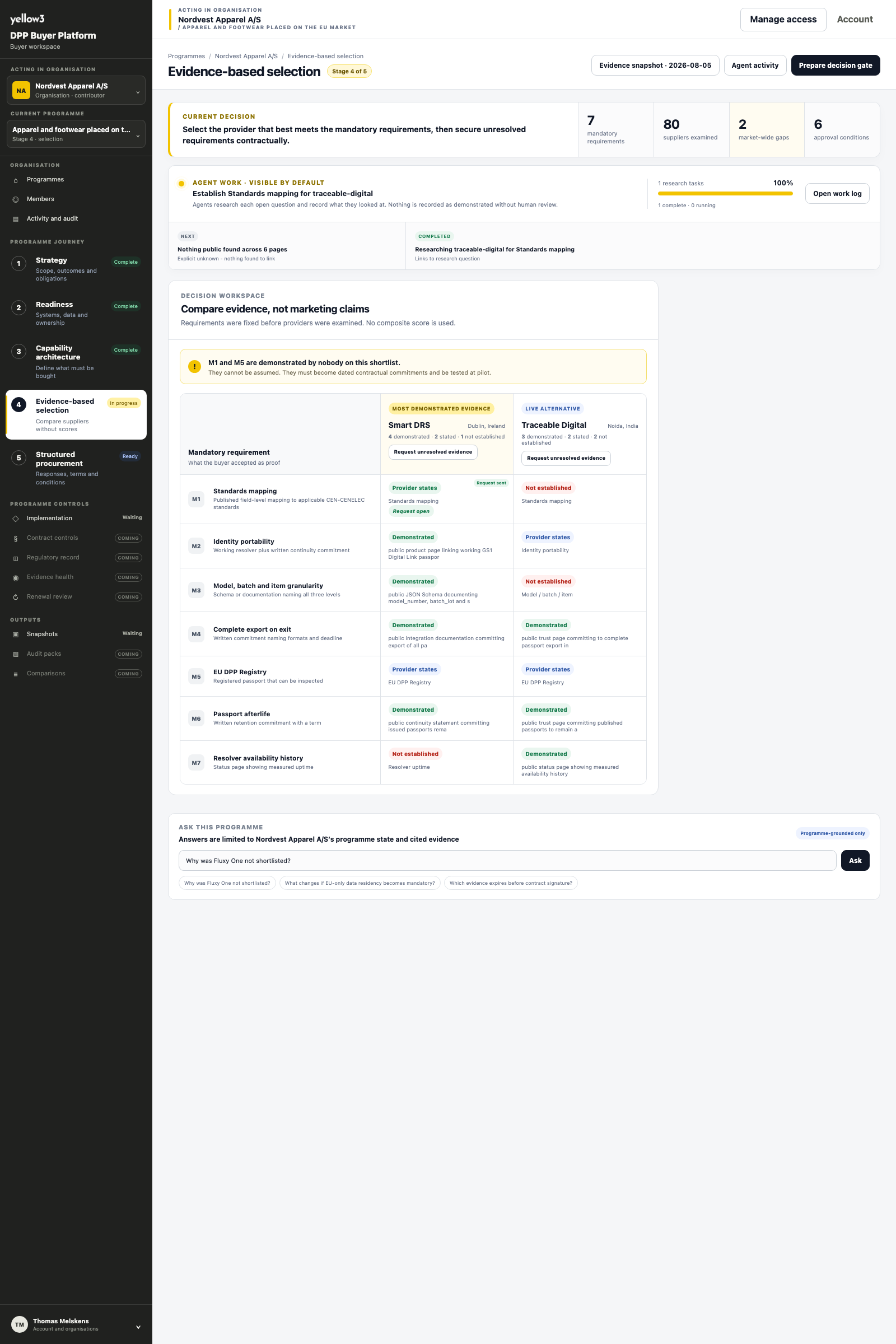
The Buyer Platform structures the buyer-side procurement evidence trail. It does not run an e-tender, award a contract or replace legal sign-off.
The buyer defines what the provider must deliver before comparing providers.
Where public evidence is not enough, the buyer sends provider-specific evidence requests for the unresolved requirement.
Provider answers and private documents remain attributed to the provider and do not overwrite yellow3 independent findings.
Open evidence items remain visible as procurement conditions instead of being converted into negative capability findings.
The providers actually being evaluated are compared requirement by requirement, without a composite score or preferred-provider ranking.
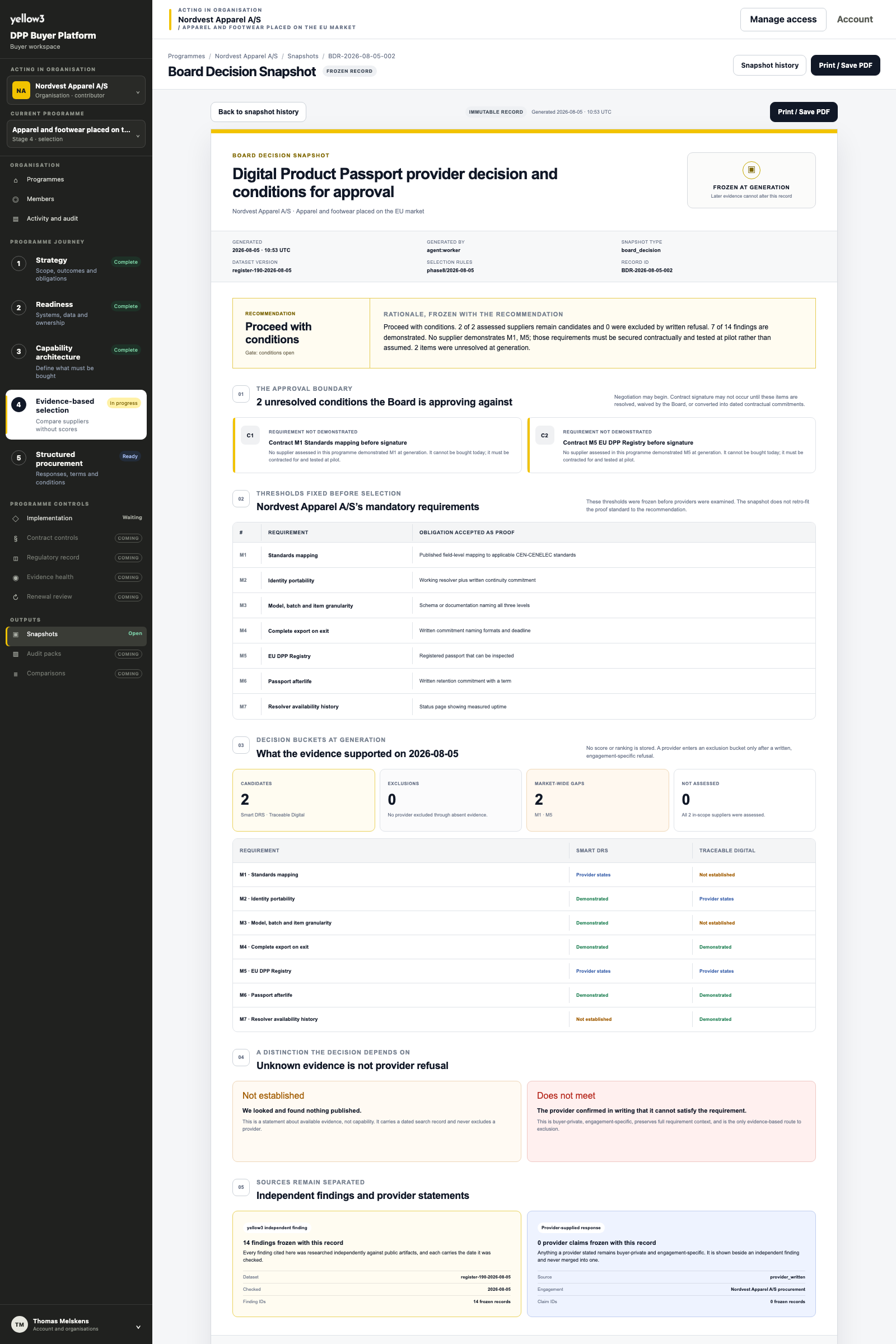
A Board Decision Snapshot preserves the provider population, evidence, unresolved conditions and decision state as they stood on the generation date.
A provider response can change a buyer decision, but it never silently rewrites yellow3’s independent Supplier Register record.
Strategy, readiness, architecture, evidence-based selection, structured procurement, implementation and immutable decision snapshots are built. The remaining continuous controls and assembled audit output are being completed before public launch.
The complete five-stage buyer journey is operating against the live database.
The selected provider does the technical work while yellow3 structures and records the programme, gates and evidence.
Board Decision Snapshots freeze what was known, unresolved and approved on a date and can be printed or saved as PDF.
These modules are intentionally described in future tense until they are built, exported and verified. They will not be marketed as available before then.
Will structure clause requirements, provider positions, deviations, evidence and counsel review without replacing legal advice.
Will maintain sourced regulatory instruments, versions and programme references without asserting legal applicability for the buyer.
Will show evidence currency, revalidation work and live drift while leaving historical snapshots unchanged.
Will surface factual market changes and newly demonstrated requirements without ranking providers or declaring a universal “better” supplier.
Will assemble the programme decision record, evidence references, approvals and audit trail into a distinct exportable proof package.
Launch rule: these cards change from future tense to present tense only after the corresponding module is built and a real exported screen exists.
The Board Decision Snapshot records exactly what was known on the generation date, which requirements remained unresolved and what the board was being asked to approve.
Later evidence cannot rewrite the earlier record.
The recommendation never appears without its rationale.
Unresolved items remain prominent because those are the approval conditions.
The record is designed for screen, A4 print and board-pack PDF.
Plan it. Buy it. Implement it. Prove it.
Every paid plan includes the same A-to-Z method. Price scales with programme size, never by withholding evidence integrity from smaller companies.
Very small manufacturers, importers and specialist brands.
Established SMEs with a broader product and supplier base.
Manufacturers and brands with several systems, markets or divisions.
Groups, major brands and complex international programmes.
A guided Digital Product Passport diagnostic: create one programme and work through a structured diagnostic of your position, including applicability derived from the information you provide. 1 programme, 1 user. No material ingestion, evidence extraction, provider engagement or Board Decision Snapshots - those are what a paid programme is.
Build the requirements, facts and evidence your organisation needs to make a defensible Digital Product Passport decision.